Romanian Deadlift (RDL): Complete Exercise Guide
Master RDL form, understand the muscles worked, avoid common mistakes, and learn how to program RDLs for strength and hypertrophy — with links to our RDL calculators.
The Romanian deadlift (RDL) is named after Romanian weightlifter Nicu Vlad, who was observed performing the exercise by American coaches in the 1990s. Unlike the conventional deadlift, the RDL starts from the top (standing position) and descends under control, with only a slight knee bend [2].
The key distinction is the emphasis on the eccentric (lowering) phase. You lower the bar along your thighs until you feel a deep hamstring stretch, then reverse the movement by driving your hips forward. This controlled eccentric loading makes the RDL exceptionally effective for hamstring hypertrophy and injury prevention [3].
Anatomy
Muscles worked in the Romanian deadlift
The RDL is a posterior chain-dominant exercise with significant upper back and core involvement.
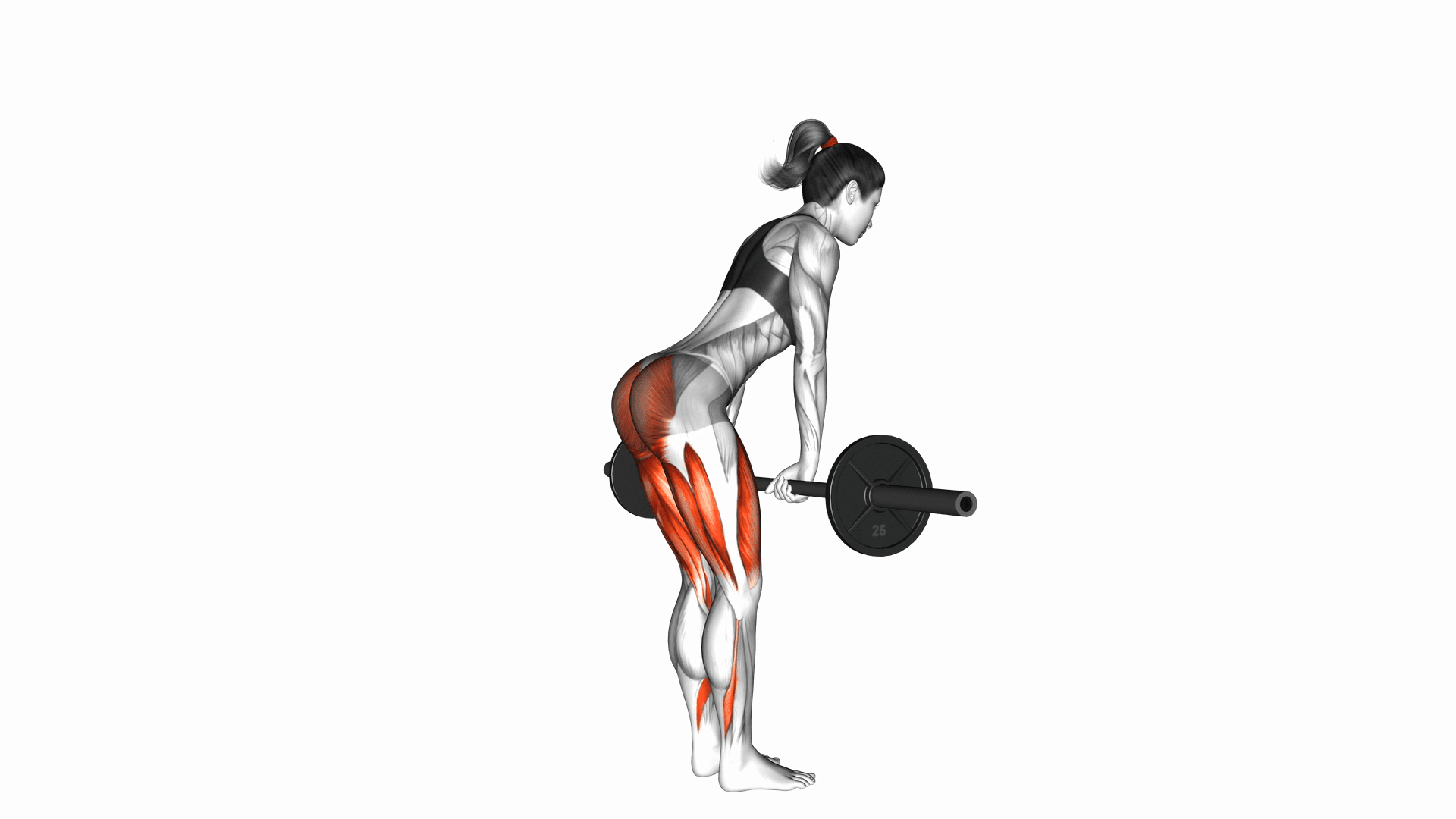
| Muscle group | Role | Activation level |
|---|---|---|
| Hamstrings | Primary mover (hip extension + knee stabilization) | Very high |
| Glutes | Primary mover (hip extension at lockout) | High |
| Erector spinae | Isometric stabilizer (maintains spinal position) | High |
| Lats & traps | Keep bar close to body, scapular retraction | Moderate |
| Forearms / grip | Bar holding (especially during slow eccentrics) | Moderate |
| Core | Anti-flexion stabilization | Moderate |
EMG research shows the RDL produces higher hamstring activation than leg curls, good mornings, and glute-ham raises [1].
Technique
How to perform the Romanian deadlift: step by step
Follow these cues for safe, effective RDL form.
Set up
Stand with feet hip-width apart, bar in hands at hip height (unrack from a squat rack or deadlift up first). Grip slightly wider than shoulder width. Shoulders pulled back, chest up.
Initiate the hinge
Push your hips straight back — think about closing a car door with your glutes. Keep a slight bend in the knees (15-20°) but do NOT squat down. The movement comes from the hips, not the knees.
Lower with control
Slide the bar down your thighs, keeping it in contact with your legs. Descend until you feel a strong stretch in your hamstrings — typically mid-shin level. Your back stays neutral throughout.
Feel the stretch
At the bottom, you should feel a deep hamstring stretch. Your torso will be roughly 15-30° above parallel depending on your flexibility. The bar should be at or just below knee level.
Drive hips forward
Reverse the movement by squeezing your glutes and driving your hips into the bar. Think about thrusting your hips to the wall in front of you. The bar travels straight up along your legs.
Lock out
Finish standing tall with hips fully extended, glutes squeezed, and shoulders back. Do NOT hyperextend your lower back at the top. The bar hangs at your hips.
Common mistakes
5 mistakes that ruin your RDL
Avoid these errors to maximize hamstring stimulus and prevent injury.
Rounding the lower back
Fix: Maintain a neutral spine by engaging your lats and bracing your core. If your back rounds, you've gone too deep for your current flexibility.
Bending the knees too much
Fix: The RDL is a hip hinge, not a squat. Keep knees at a fixed slight bend (15-20°). If your knees are bending more, you're squatting the weight down.
Letting the bar drift away from the body
Fix: The bar must stay in contact with your thighs and shins throughout. Engage your lats to 'pull' the bar into your body.
Using too much weight
Fix: The RDL is about control and stretch, not maximal load. If you can't control the eccentric for 2-3 seconds, the weight is too heavy.
Hyperextending at lockout
Fix: Stand tall, don't lean back. Overextending the lumbar spine at the top compresses spinal discs and wastes energy.
Comparison
Romanian deadlift vs conventional deadlift
Same family, different goals. Here's how they compare.
| Factor | Romanian Deadlift (RDL) | Conventional Deadlift |
|---|---|---|
| Start position | Standing (top-down) | Floor (bottom-up) |
| Knee bend | Minimal (15-20°) | Significant (45-90°) |
| Primary emphasis | Eccentric / hamstring stretch | Concentric / total body pull |
| Quad involvement | Minimal | Significant |
| Typical load | 60-75% of deadlift 1RM | 100% (it IS the max) |
| Best for | Hypertrophy, injury prevention, accessory | Max strength, competition |
The RDL and conventional deadlift complement each other perfectly. Use the conventional deadlift as your primary strength builder and the RDL as an accessory to develop the posterior chain, build hamstring resilience, and improve lockout strength.
Want to know your expected RDL based on your deadlift? Use our RDL to Conventional Deadlift Calculator.
Programming
How to program Romanian deadlifts
Rep ranges, frequency, and placement in your training week.
| Goal | Sets × Reps | % of DL 1RM | Rest | Frequency |
|---|---|---|---|---|
| Strength | 3-4 × 3-6 | 65-75% | 2-3 min | 1-2x/week |
| Hypertrophy | 3-4 × 8-12 | 55-65% | 60-90 sec | 2-3x/week |
| Injury prevention | 2-3 × 10-15 | 45-55% | 60 sec | 2-3x/week |
Where to place RDLs in your program
- • After conventional deadlifts: Use as a supplemental lift (like FSL or BBB in 5/3/1). Lower the weight and focus on the stretch.
- • On a separate day: Pair with upper body pressing for a push/pull split.
- • As a primary hinge: On lighter days or during hypertrophy blocks, the RDL can be your main hip hinge movement.
Benefits
Why every deadlifter should do RDLs
The RDL offers unique benefits that other exercises can't replicate.
Hamstring hypertrophy
The RDL loads the hamstrings through a long range of motion with a deep eccentric stretch — the primary driver of muscle growth.
Injury prevention
Eccentric hamstring training reduces hamstring strain risk. Athletes who train RDLs have lower hamstring injury rates.
Improved lockout strength
The RDL trains the exact range of motion where conventional deadlifts often stall — from knees to lockout.
Better hip hinge mechanics
Practicing the RDL reinforces the hip hinge pattern, which transfers to conventional and sumo deadlifts.
Variations
Romanian deadlift variations
Adapt the RDL to your equipment and specific training goals.
Dumbbell Single-Leg RDL
The single-leg variation is a powerhouse for correcting muscle imbalances and improving hip stability. By working one leg at a time, you engage the glute medius and core more intensely than during the bilateral version.
Key differences:
- • Higher balance requirement
- • Increased glute medius activation
- • Minimal spinal loading compared to barbell
Dumbbell RDL
Allows for a more natural hand position and easier setup than a barbell.
B-Stance RDL
A hybrid between single and double leg, offering stability with unilateral focus.
Snatch-Grip RDL
Increases upper back demand and range of motion for advanced lifters.
RDL Tools
Use our RDL calculators
Pair this guide with our interactive Romanian deadlift tools.
FAQ
Romanian deadlift questions
Common questions about RDL form, programming, and benefits.
References
Sources
Research cited in this guide.
[1] Muscle Activation During Various Hamstring Exercises
McAllister MJ, et al. J Strength Cond Res. 2014;28(6):1573-1580.
[2] Essentials of Strength Training and Conditioning (4th ed.)
Haff GG, Triplett NT. Human Kinetics. 2016.
[3] The Mechanisms of Muscle Hypertrophy and Their Application to Resistance Training
Schoenfeld BJ. J Strength Cond Res. 2010;24(10):2857-2872.